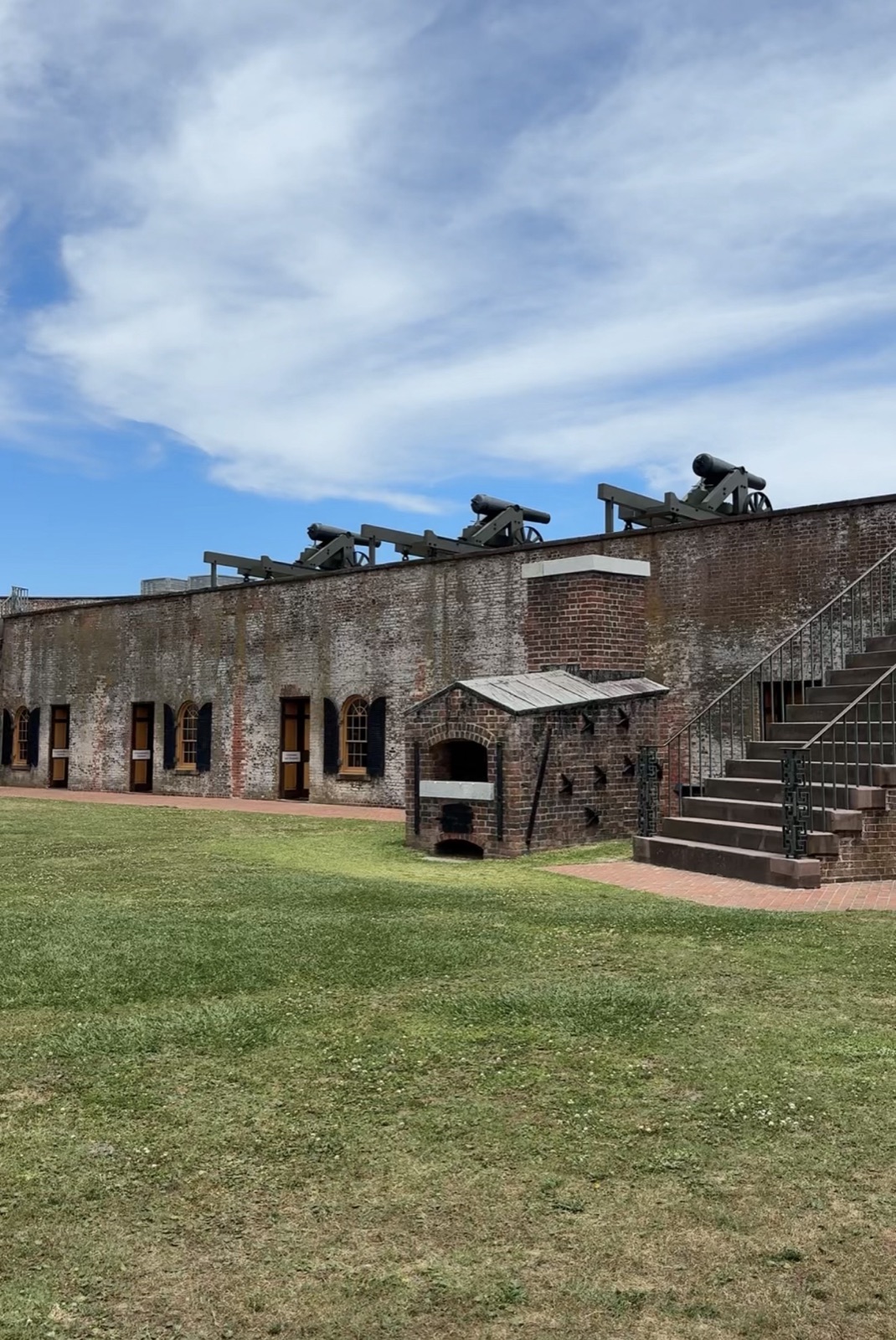
Fort Macon State Park sits at the eastern tip of Bogue Banks, one mile east of Atlantic Beach. It is one of the most visited state parks in North Carolina, and once you spend a few hours here it is easy to understand why. The park contains a beautifully preserved Civil War era fort and one of the best ocean beaches on the Crystal Coast, all in the same place and all completely free. It is a genuinely exceptional half day or full day visit.
Most people who visit Fort Macon come for the history or the beach and end up spending the entire day because the combination is so good. The fort itself takes about an hour to explore properly. The beach on the south side of the park is wide, clean, and consistently less crowded than the beaches further west on Bogue Banks. And the snorkeling off the rock jetty at the eastern tip of the park is some of the best accessible snorkeling in North Carolina.
History of Fort Macon
Fort Macon was originally built between 1826 and 1834 to protect Beaufort Inlet in the years following the War of 1812. The federal government was investing in coastal defense infrastructure up and down the Atlantic coast during this period, and Fort Macon was part of that effort. The fort is a pentagonal masonry structure with five bastions, built in the style of the Third System of American coastal fortifications.
When North Carolina seceded in 1861, Confederate forces seized the fort in April of that year. Union forces recaptured it on April 26, 1862, after a combined naval and land bombardment that lasted about eleven hours. It was one of the first significant Union victories in the Eastern Theater of the war and a strategically important one since it gave the Union control of Beaufort Inlet and the port of Beaufort. The fort was used as a Union supply depot and prison for the remainder of the war.
After the Civil War the fort fell into disuse and then disrepair. The Civilian Conservation Corps restored it in the 1930s, which is why it is in such remarkable condition today. Fort Macon became North Carolina's first state park in 1924, before the CCC restoration work even began.
Touring the Fort
The self guided tour takes you through the interior of the pentagonal fort at your own pace. The casemates contain original cannon emplacements, and you can walk the length of the fort walls from bastion to bastion. The parade ground at the center of the fort gives you a sense of the scale of the structure. The sally port entrance is the original main gate and is one of the more photogenic spots in the park.
The interior rooms that housed the garrison during the Civil War are largely intact and well interpreted with signage that explains the history clearly. From the top of the fort walls you get elevated views across Beaufort Inlet toward Cape Lookout to the south and back toward Beaufort and the Bogue Banks bridge to the west. The views alone are worth making the climb.
The interpretive signage throughout the fort is some of the best in the NC state park system. It covers the engineering of the fort, the events of April 1862 in detail, and the daily life of the soldiers who were stationed here during the occupation. Plan for at least an hour if you want to read everything properly.
The Beach at Fort Macon
The ocean beach on the south side of the park is one of the cleanest and most consistently uncrowded beaches on Bogue Banks. The park has bathhouses with showers and changing areas, and a concession stand that operates in season. The beach itself stretches along the southern face of the park with views of the Atlantic and the shipping traffic moving through Beaufort Inlet.
The water here is generally clear and the bottom is sandy, making it a good swimming beach. Because it is a state park rather than a municipality the crowds stay manageable even on busy summer weekends, though the parking lot does fill up early. Arriving before 10 AM in July and August is strongly recommended.
Snorkeling at Fort Macon
The rock jetty at the eastern tip of the park is one of the best accessible snorkeling spots in North Carolina. The rocks create structure that attracts a variety of marine life, and the water on calm days is remarkably clear for an Atlantic coast location. Flounder, rays, various species of reef fish, and occasional sea turtles are common. The jetty area is sheltered enough that even moderately strong swimmers can explore it comfortably.
The key is going on a calm day with good visibility. After a storm or during periods of rough surf the water turns murky and the snorkeling is not worth it. Mornings tend to have better conditions than afternoons. Bring your own mask and fins as there are no gear rentals anywhere in the park or in the immediate area. The parking lot near the jetty fills quickly on good snorkeling days, so arrive early.
Hiking and Nature
A two mile nature trail runs through the maritime forest on the sound side of the park and along the shoreline of Bogue Sound. The trail is flat and easy to walk and passes through several distinct coastal habitats including maritime shrub and live oak forest. Birding is particularly good during spring and fall migration because the park sits directly at Beaufort Inlet, which is a significant migratory corridor. Shorebirds, wading birds, and raptors are commonly seen throughout the year.
The park is also a good spot to watch boat traffic through Beaufort Inlet, which is one of the busiest inlets on the NC coast. Sailboats, fishing charters, container ships, and Coast Guard vessels all pass through regularly.
Practical Tips
- Arrive before 10 AM in summer, especially on weekends. The parking lot fills quickly and there is limited overflow parking.
- Bring your own snorkeling gear. There are no rentals on site or nearby.
- The bathhouse has showers and changing rooms, which makes a full beach day much more comfortable.
- The concession stand operates in season but brings limited options. Bring extra food and water if you plan to spend a full day.
- The fort is fully ADA accessible at ground level. The upper walls and some interior areas involve uneven surfaces and steps.
- There is no shade at the beach or on the fort walls. Sun protection is essential, especially from May through September.
Frequently Asked Questions
Is Fort Macon State Park worth visiting?
Yes, without question. The fort and the beach together make it one of the best free state parks in North Carolina. Even if you have seen a lot of Civil War sites, Fort Macon is unusually well preserved and the setting at the inlet is genuinely beautiful.
How long does Fort Macon take?
Plan for two to three hours minimum if you want to tour the fort and spend time on the beach. A full day is easy to fill if you add the nature trail and snorkeling at the jetty.
Is there an admission fee at Fort Macon?
No. Fort Macon State Park is free to enter and the parking is free. It is one of the best free attractions on the entire NC coast.
What is Fort Macon known for?
Fort Macon is known for being one of the best preserved Civil War era masonry forts in the Southeast, for its ocean beach on the park's south side, and for the snorkeling at the eastern jetty, which is one of the best accessible snorkeling spots in North Carolina.