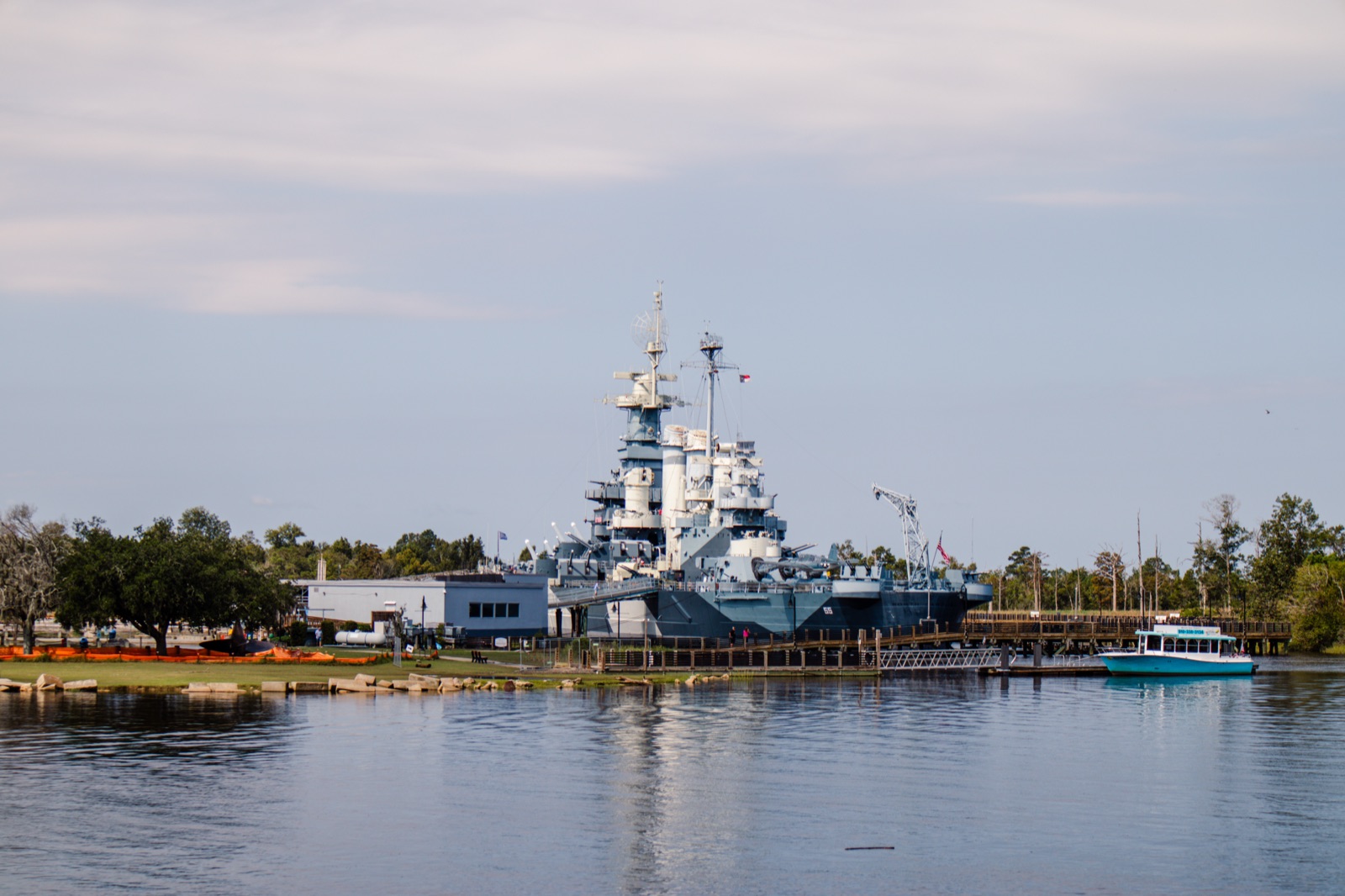
The Battleship North Carolina is moored on the western bank of the Cape Fear River directly across from downtown Wilmington, visible from the Riverwalk. It is a World War II battleship that served in every major naval offensive in the Pacific theater from 1942 to 1945 and earned 15 battle stars, more than any other battleship in the Pacific fleet. Today it is a museum ship and one of the most visited historical sites in all of North Carolina. Getting on board and exploring the ship in person is a genuinely powerful experience regardless of your prior interest in military history.
The History of the Ship
The USS North Carolina (BB 55) was launched in June 1940 at the Brooklyn Navy Yard. At the time of her commissioning in April 1941, she was the most powerful warship in the United States Navy. She was the lead ship of the North Carolina class of battleships, the first new US battleship design after a 15 year building moratorium established by the Washington Naval Treaty.
She carried nine 16 inch guns in three triple turrets capable of firing shells weighing over 2,700 pounds a distance of more than 20 miles. Her anti aircraft battery included dozens of 20mm and 40mm guns that made her one of the most formidable air defense platforms in the fleet. She had a crew of over 2,300 men and displaced 44,800 tons fully loaded.
The North Carolina arrived in the Pacific in August 1942, just as the fierce fighting around Guadalcanal was beginning. She participated in the Guadalcanal campaign, the campaigns in the Gilbert and Marshall Islands, the invasion of Saipan and Tinian, the Battle of the Philippine Sea, the invasion of Guam, the Leyte Gulf campaign in the Philippines, the invasion of Iwo Jima, and the final operations against the Japanese home islands in 1945. She was present at the formal Japanese surrender in Tokyo Bay on September 2, 1945.
On September 15, 1942, a Japanese submarine torpedo struck the North Carolina and killed five men. The ship lost 68 inches of her bow but remained operational and made repairs without returning to a major shipyard. The five men killed were the only combat deaths aboard the ship during the entire war.
Saving the Ship
The North Carolina was decommissioned in 1947 and placed in the Reserve Fleet. By 1958 the Navy planned to scrap her. North Carolina residents launched a statewide campaign called "Save Our Ship" to raise money to bring the battleship to Wilmington as a permanent memorial. The campaign collected over $330,000, largely from schoolchildren across the state who contributed dimes and quarters. In 1961 the ship was towed to Wilmington, where she has been moored ever since.
That story matters when you visit the ship. The North Carolina belongs to the people of the state in a way that is unusual for a historical site. The effort to preserve her was a genuinely grassroots campaign and the ship has been a beloved part of Wilmington's waterfront for over 60 years.
What To See on the Tour
The self guided tour covers all nine decks of the ship and takes 2 to 3 hours for a thorough visit. Most people do not see everything on a single visit. Here are the highlights:
The Main Gun Turrets
The three 16 inch gun turrets are the most dramatic feature of the ship. Turret 2 is accessible to visitors and you can walk inside to see the massive gun mechanisms and understand the scale of the weapons. The guns themselves are 66 feet long and required a crew of 95 men each to operate. The shells they fired weighed as much as a small car. Standing inside the turret gives you a real sense of the engineering and the human effort that it took to operate a battleship in combat.
The Bridge and Combat Information Center
The bridge is where the captain commanded the ship. The combat information center directly below the bridge was the nerve center for tracking targets and coordinating the ship's weapons and defenses. Both spaces are largely intact and give you a strong sense of what command and control looked like on a WWII era warship. The bridge offers elevated views across the Cape Fear River toward downtown Wilmington.
Crew Quarters and Mess Decks
The living spaces for the 2,300 man crew are some of the most humanizing parts of the tour. The berthing areas with their rows of narrow hammocks and bunks, the mess decks where the crew ate, and the small personal spaces that men lived in for months at a time during combat operations all make the abstract history of the war concrete. The North Carolina's crew were men from North Carolina and across the country, many of them teenagers, living and working in these spaces.
The Engine Room
The engine room holds the massive turbines that drove the ship at speeds up to 28 knots. The scale of the machinery is overwhelming. The North Carolina was powered by eight Babcock and Wilcox boilers producing steam for four geared turbines generating over 120,000 shaft horsepower. The engine room access is limited but you can view the main machinery spaces and get a sense of the industrial power that propelled the ship.
The Sick Bay and Dental Office
The medical facilities aboard the ship are often overlooked but they are worth seeing. A 2,300 man crew meant the ship functioned as a small city, and that included full medical and dental facilities capable of handling combat casualties at sea. The sick bay includes an operating room, a pharmacy, and patient wards. It is a reminder that the ship was a complete world unto itself during deployments that could last many months.
The Ghost Stories
The North Carolina has a well established reputation as one of the most haunted sites in North Carolina. The ship has been featured on multiple paranormal investigation programs and the battleship offers official ghost walks during Halloween season that sell out every year.
The most frequently reported sightings involve a young sailor who has been seen in various parts of the ship, particularly in the forward areas near where the torpedo damage occurred in 1942. Other visitors have reported unexplained sounds, cold spots, and the sense of being watched in the crew quarters and lower decks. Whether or not you believe in any of it, the ship is an atmospheric and isolated environment that is easy to find unsettling after dark, and the ghost walk events are genuinely fun if you are visiting in October.
Getting There
The battleship is at 1 Battleship Road on the west bank of the Cape Fear River. From downtown Wilmington, cross the Cape Fear Memorial Bridge and follow the signs immediately after the bridge. Free parking is available on site.
During operating season, a small passenger ferry runs from the downtown Wilmington Riverwalk to the battleship. The ferry is a scenic and convenient option if you are already on the Riverwalk. Check the battleship's website for current ferry schedules as they vary by season.
Tips for Your Visit
- Wear comfortable shoes. The ship has steep ladders between decks and uneven surfaces throughout. Sandals and dress shoes are a bad idea. The tour involves real physical movement through tight spaces.
- Allow at least 2 hours. You can rush through the highlights in 90 minutes but the ship rewards spending more time. The crew quarters and less visited lower decks are where the most interesting and human details are.
- Bring the kids. The battleship is one of the best family friendly attractions in the Wilmington area. Children are almost universally fascinated by the scale of the guns, the machinery, and the idea of thousands of people living aboard a ship.
- The gift shop has good books. The bookstore at the entrance has a solid selection of WWII Pacific naval history and battleship specific titles that you will not find at most general bookstores.
- The view back toward downtown is worth it. Standing on the main deck of the battleship and looking across the Cape Fear River toward the Wilmington skyline is one of the better views in the city. Bring a camera.
Frequently Asked Questions
Is the Battleship North Carolina worth visiting?
Yes. It is one of the most impressive preserved warships in the country and the self guided tour is genuinely fascinating. Plan for at least 2 hours. Anyone with family members who served in the Pacific in WWII will find the visit particularly meaningful.
How long does the Battleship North Carolina tour take?
2 to 3 hours for a thorough self guided tour covering all nine decks. You can see the highlights in about 90 minutes. Families with young kids should plan for closer to 3 hours to account for extra time in the gun turrets and on the main deck.
Can you drive to the Battleship North Carolina?
Yes. There is free parking on site at 1 Battleship Road. Cross the Cape Fear Memorial Bridge from downtown Wilmington and follow the signs immediately after the bridge. A seasonal ferry also runs from the downtown Riverwalk.
Is the Battleship North Carolina haunted?
The ship has been featured on multiple paranormal investigation shows and has an active reputation as one of the most haunted sites in NC. The battleship runs official ghost walk events during Halloween season that sell out quickly. Whether or not the ghost stories are real, the ship is a genuinely atmospheric place to visit after dark.
How many battle stars did the Battleship North Carolina earn?
15 battle stars, earned for service in every major Pacific naval offensive in WWII from Guadalcanal in 1942 through the final operations against Japan in 1945. She was present at the Japanese surrender in Tokyo Bay on September 2, 1945.